



Introduction: The Era of High-Frequency Solar
The solar industry has evolved. Fifteen years ago, hourly averages of irradiance were sufficient for simple grid-tied systems. Today, we are operating multi-megawatt utility-scale plants with bifacial modules, single-axis trackers, and highly dynamic inverters using advanced MPPT (Maximum Power Point Tracking) algorithms.
In this modern landscape, light doesn’t just change by the hour; it changes by the second.
Yet, a critical gap remains in many monitoring systems: the speed gap between atmospheric changes, what the inverter is doing, and what the reference pyranometer is recording. Bridging this gap requires moving beyond “standard” Class A sensors and embracing sub-second response technology.
Here is why the speed of your sensor determines the accuracy of your asset’s financial reality.
The “Hidden” Energy: Catching the Cloud Edge
The primary reason response time matters is a phenomenon known as the “cloud edge” or lensing effect.
When cumulus clouds pass over a site, irradiance doesn’t just drop from 1000 W/m² to 200 W/m². Just before the cloud covers the sun, the water vapor at the cloud’s edge acts like a magnifying glass, refracting sunlight.
For a few seconds, irradiance can spike dramatically—often exceeding 1,400 W/m².
The Problem with Thermal Lag Traditional, high-quality thermopile pyranometers rely on a black-painted surface physically heating up and cooling down to generate a voltage. This process has inherent thermal inertia. A standard “fast” ISO 9060 Class A sensor might take anywhere from 3 to 10 seconds to register 95% of that new measurement.
By the time a traditional sensor has begun to “warm-up” to record that 1,400 W/m² spike, the cloud has already passed, and the irradiance has dropped. The sensor averages out the event, perhaps only recording a peak of 1,100 W/m².
You have just missed the most intense energy event of the day.
Real-World Impact #1: The EPC Commissioning Headache
For Engineering, Procurement, and Construction (EPC) firms, time is money, and commissioning is the final hurdle to getting paid.
During Performance Acceptance Tests, the EPC must prove the plant’s Performance Ratio (PR) meets contractual guarantees. This requires comparing the energy going into the system (measured by the pyranometer) vs. the energy coming out (measured by the inverter).
Modern inverters react almost instantaneously to irradiance changes. If the reference pyranometer is lagging by 5 or 10 seconds during variable weather, the data input and output become misaligned.
The Result: The data scatter plot looks messy and uncorrelated. The calculated PR fluctuates wildly, leading to failed tests, arguments with Owner’s Engineers, and extended time on site. EPCs need a sensor that reacts as fast as the inverter to prove the plant works, pass the test, and hand over the project.
Real-World Impact #2: The Developer’s “Invisible Clipping”
For developers and asset owners, long-term yield and accurate modeling are paramount.
If your sensor misses those high-irradiance “cloud edge” spikes, you lose visibility into how your equipment is actually behaving under stress.
When irradiance hits 1,400 W/m², your inverter will likely reach its power limit and “clip” the excess energy. However, if your slow pyranometer only records 1,100 W/m², your data analysis will show the inverter capping power at a level where it shouldn’t be clipping.
The Result: Analysts may incorrectly flag inverters as underperforming or broken, triggering unnecessary O&M site visits. Furthermore, without capturing these peaks, financial models for future projects will underestimate the true solar resource variability of the region.
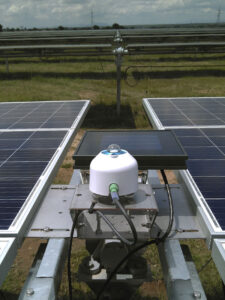
The Solution: Sub-Second Precision with the MS-80SH
To align measurement data with the reality of modern solar equipment, EKO Instruments developed the MS-80SH.
Unlike traditional designs limited by thermal inertia, the MS-80SH utilizes a patented isolated thermopile design and a quartz diffusor. This allows it to achieve an ISO 9060:2018 Class A response time (t95%) of less than 0.5 seconds.
Independent how you sample data it catches the cloud edge spikes that others miss. It aligns perfectly with high-speed inverter data.
Furthermore, this fast-response detector technology makes the sensor inherently immune to thermal offsets (Zero-Offset A and B), ensuring that its speed is matched by exceptional stability.
Conclusion
In today’s solar market, high-quality data isn’t just about having a “Class A” sticker on the sensor. It’s about the timing of that data.
When your inverters are making decisions every second, your reference sensor cannot afford to be several seconds behind. By choosing sub-second response technology like the MS-80SH, EPCs can accelerate commissioning, and owners can gain a true picture of their asset’s performance.
Don’t let valuable data get lost in the lag.


