


Team & Event Background
The Innoptus Solar Team is a student engineering team from KU Leuven, Belgium, founded in 2004. In July and August 2026, the team made its debut at the Electrek American Solar Challenge (ASC) with its eleventh-generation solar car, Infinite Apollo.
The eight-day race ran from July 25 to August 1, 2026, along the Great River Road and historic Route 66, from Minneapolis, Minnesota, to Amarillo, Texas, crossing eight U.S. states.
Starting from third place after qualifying, Innoptus moved into second position early and took the overall lead on day five, holding it to the finish. The team covered 4,298.9 km to win the event, becoming the first European team in ASC history to do so.
The Challenge: Accurate Solar Irradiance Data
In a distance-based, sun-powered race, energy income is the strategic currency. Decisions about driving speed, optional scoring loops, charging and energy management depend on how much solar energy the car is expected to harvest in the next minutes and hours.
Cloud cover, haze and diffuse light conditions can change quickly and are only partially captured by public forecasts. Accurate, real-time irradiance measurements therefore provide critical ground-truth data for race-day strategy.
EKO MS-80SH Pyranometer Deployment
Earlier in the season, the team visited EKO Instruments in The Hague and received several EKO MS-80SH pyranometers, along with a tilting mechanism enabling Plane-of-Array (POA) irradiance measurement in addition to Global Horizontal Irradiance (GHI).
During ASC 2026, the sensors were deployed across four vehicles:
- Chase vehicle (“Brains”) — an MS-80SH mounted on top provided a real-time measurement of the irradiance Infinite Apollo had just driven through.
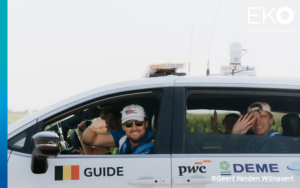
- Lead vehicle (“Guide”) — fitted with the tilting mechanism to measure POA irradiance at stops and enable direct GHI vs. POA comparisons.
- Support vehicle (“Hands”) — carried a backup unit for a potential Brains–Hands vehicle swap.
- Scout vehicle (“Eagle”) — travelled more than an hour ahead, measuring irradiance to compare with forecasts and refine the team’s estimate of the conditions ahead.
Using GHI and POA Data for Race Strategy
The team continuously measured GHI from the chase and scout vehicles and measured both GHI and POA irradiance at stops.
Before race day, the data was used to validate and locally correct irradiance forecasts feeding the team’s in-house strategy and speed-optimization software.
During the race, the measurements supported two key decisions:
- Speed and energy strategy: real-time GHI measurements helped correct short-term irradiance forecasts, refining speed targets and the energy budget for the road ahead.
- Tilt-or-flat charging: comparing POA against GHI helped determine whether tilting the solar array toward the sun would increase energy yield or whether keeping it flat would capture more diffuse irradiance under cloudy conditions.
Real-World GHI vs. POA Measurement
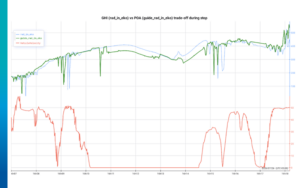
On day two, at the Normal, Illinois control and loop stop, conditions were very cloudy. The team needed to decide whether to tilt the solar panel toward the hidden sun or leave it flat to capture more diffuse sunlight.
Two MS-80SH pyranometers provided an immediate comparison: one measured horizontal GHI from the chase vehicle, while the second measured tilted POA irradiance from the lead vehicle.
In the graph below, “rad_in_eko” represents the horizontal GHI measurement and “guide_rad_in_eko” the tilted POA measurement.
During this stop, the horizontal measurement was higher, supporting the team’s decision to keep the solar panel flat.
Impact & Results
Across the eight-day race, real-time irradiance measurements helped reduce reliance on forecast data alone and supported the team’s energy-management decisions.
Innoptus progressed from third place in qualifying to the overall lead on day five, ultimately covering 4,298.9 km and becoming the first European team to win the American Solar Challenge.
“Over 1,500 miles and eight days of changing skies, the EKO MS-80SH sensors gave us numbers we could trust to the minute — that reliability is what let us make difficult tilt-or-flat calls with confidence instead of guesswork.”
Quinten Duyck, Race Strategist, Innoptus Solar Team


