


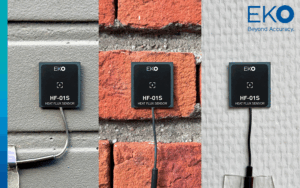
Measuring the thermal performance of building facades requires sensors that stay reliably attached to uneven surfaces over time. At the Faculty of Architecture and the Built Environment at Delft University of Technology (TU Delft), researchers face this challenge directly when conducting in-situ U-value measurements on existing buildings.
Prof. Martin Tenpierik and his team selected the EKO HF-01S Heat Flux Sensor for its compact form factor, high sensitivity (~55 μV/(W/m²)), and robust encasing — enabling consistent surface contact regardless of facade material.
“One of the important advantages of the EKO HF-01S is its small size combined with good sensitivity and a sturdy encasing. For building industry applications — such as measuring U-values of facades — a small, lightweight sensor remains attached to the surface more reliably over time. With larger sensors it is sometimes unclear whether you are measuring brick, mortar, or both. This problem does not arise with the EKO sensor. Despite its compact size, the HF-01S achieves a sensitivity of ~55 μV/(W/m²) — comparable to much larger sensors on the market.”
Prof. Martin Tenpierik — Faculty of Architecture and the Built Environment, Delft University of Technology


