


The “Copy-Paste” Standard
If you look at the technical specifications for any utility-scale solar project built in the last five years, you will find the same phrase pasted into almost every contract:
“Monitoring system shall comply with IEC 61724-1 Class A standards.”
It is the industry’s safety blanket. It assures investors and owners that the data will be accurate, the sensors will be precise, and the performance analysis will be rigorous.
But there is a dirty secret in the industry: Writing the standard in the contract is easy. Actually following it is nearly impossible with legacy tools.
The Excel Trap
IEC 61724-1 doesn’t just dictate which hardware you buy (like the MS-80SH) rather it dictates how you handle the data after it is measured.
The standard calls for rigorous, continuous quality control. It implies you should be flagging data based on physical limits, checking for inconsistencies, and verifying timestamp alignment. To be truly compliant, you should be performing these validity checks on your dataset consistently.
Now, ask yourself: Who is doing that and how?
In most companies, “compliance” is a busy engineer staring at a massive Excel spreadsheet once a month, trying to manually spot outliers in 50,000 rows of data.
It is slow, it may lack physical interpretation, lack knowledge about how sensors perform, is prone to human error, and frankly, it is not scalable. As your portfolio grows from one site to ten, the spreadsheet method breaks. The result? You claim compliance in the contract, but you are struggling to fulfill it in practice.
Automating the Expert Eye
We built EKO Q because we realized that manual compliance is a trap. You cannot scale “expert intuition” in a spreadsheet.
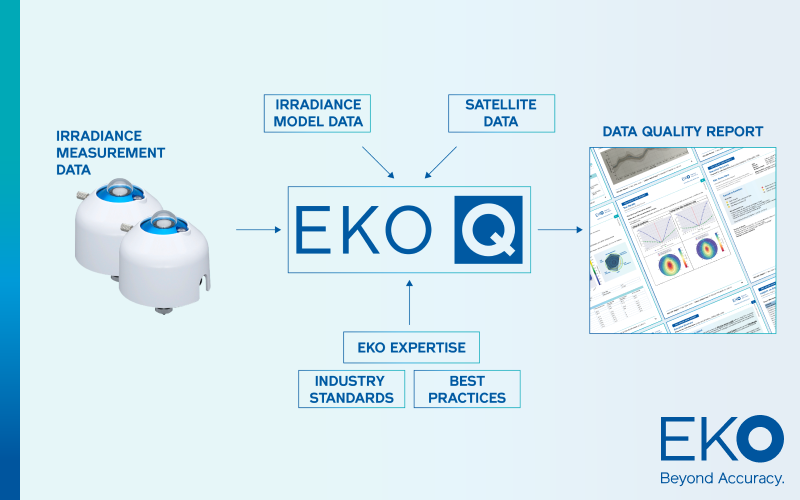
EKO Q is designed to automate the rigorous validation checks that standards imply. Instead of asking the expert engineer to manually cross-reference inverter data with pyranometer readings, you simply upload your dataset to the platform.
The software acts as an automated auditor, running specific analysis modules that align with industry best practices:
- Single Sensor Analysis: Automatically flags values that exceed physical limits (e.g., checking if irradiance > solar constant) or tracking internal sensor diagnostics like humidity and tilt (for supported sensors).
- Sensor-to-Reference Analysis: Replaces the “gut check” with math. It compares your ground sensor data against Satellite models or Clear Sky calculations to quantifiably measure consistency.
- Fleet Analysis: If you have multiple sensors, it cross-checks them against each other to instantly spot the outlier that a manual review might miss.
From “I Think” to “I Know”
The goal is to move from reactive fixing to proactive certification.
Imagine closing a commissioning phase or a quarterly review and being able to say: “Here is our performance data, and here is the analysis proving it meets our quality thresholds.”
With EKO Q, you aren’t just cleaning data; you are creating a traceable record of quality. You are proving that your monitoring system is working as promised, without spending hours building pivot tables.
The Final Word
The era of managing gigawatt portfolios with megabyte spreadsheets is over.
If you want to respect the standards you write into your contracts, you need tools that can keep up with them. EKO Q allows you to move beyond the spreadsheet and make data validation a seamless part of your workflow, not a monthly headache.
Your data is your most valuable asset. Treat it that way.