

Choosing the right pyranometer class is one of the earliest technical decisions in any solar monitoring project. Specifically, the ISO 9060:2018 standard defines three pyranometer classes: A, B, and C. Furthermore, each class carries specific accuracy, response time, and directional-error thresholds that determine which applications the sensor can serve. This guide walks through what the pyranometer class system actually means, when each class fits, and how EKO’s product line maps to it.
What ISO 9060:2018 Defines
ISO 9060:2018 classifies pyranometers against 12 performance criteria. In particular, the most important include:
- Response time: how fast the sensor tracks a change in irradiance
- Zero offsets: drift caused by thermal radiation and temperature swings
- Non-stability: annual drift in the sensor’s calibration
- Non-linearity: deviation from a linear response across the irradiance range
- Directional error: accuracy variation with sun angle
- Spectral selectivity: how uniformly the sensor responds across the solar spectrum
- Temperature response: accuracy variation with ambient temperature
- Tilt response: accuracy variation with sensor tilt
Class A carries the tightest limits on every criterion. In turn, Class B loosens each threshold, and Class C loosens them further still. Moreover, the 2018 update introduced two sub-categories: “spectrally flat” for sensors with low spectral error, and “fast response” for sensors with response times under 0.5 seconds.
Key Differences Between Each Pyranometer Class
Class A: Reference-Grade Accuracy
Class A pyranometers meet the strictest ISO 9060 thresholds. Specifically, zero offset A stays below 7 W/m², directional error remains under 10 W/m², and non-stability holds below 0.8% per year. Consequently, Class A sensors work for utility-scale PV monitoring, bankable energy reports, and IEC 61724-1 compliance. They also handle scientific reference stations, national meteorological networks, and any project where the data must survive external audit.
Class B: Balanced Performance
By contrast, Class B pyranometers hit a middle ground. Zero offset A allows up to 15 W/m², directional error up to 20 W/m², and non-stability up to 1.5% per year. Consequently, Class B fits medium-scale PV plants, agricultural monitoring, R&D setups, and any project where budget matters but data quality still counts. Most Class B sensors also serve as backup or redundant instruments alongside a Class A primary sensor.
Class C: Cost-Effective Baseline
Meanwhile, Class C pyranometers accept the widest tolerances. Zero offset A can reach 30 W/m², directional error 30 W/m², and non-stability 3.0% per year. As a result, Class C sensors work well for small PV installations, agro meteorological networks, educational projects, and dense sensor grids where cost per point outweighs single sensor accuracy.
When to Choose Each Pyranometer Class
The right pyranometer class depends on three things: who reads your data, how they use it, and what an error costs.
Pick Class A when:
- The project needs IEC 61724-1 compliance
- A bank, investor, or offtaker requires bankable-quality irradiance data
- The site sits above 1 MW and every 0.5% accuracy improvement affects revenue
- The data feeds a research programme or reference station
Consider Class B when:
- The site sits between 100 kW and 1 MW
- Data supports internal O&M decisions rather than external reporting
- The setup needs a secondary or redundant sensor alongside Class A
- The application covers agriculture, aquaculture, or greenhouse monitoring
Opt for Class C when:
- The site sits under 100 kW
- The application is a dense mesoscale network with many nodes
- The measurement supports education or citizen-science projects
- Budget is the primary constraint and 3% uncertainty is acceptable
Total Cost of Ownership by Pyranometer Class
However, the purchase price is only part of the pyranometer cost equation. In practice, three factors move the total figure over a 10-year installation:
-
- Recalibration interval. Class A sensors like the MS-80 series carry a 5-year recalibration interval, while most Class B and Class C sensors need 2-year recalibration. Therefore, fewer service visits directly reduce lifetime cost.
- Warranty length. EKO’s Class A pyranometers ship with a 5-year manufacturer warranty. By contrast, most competitor Class B and Class C sensors ship with 2-year cover.
- Cost of a measurement error. On a utility-scale plant, a 3% underreport on irradiance can mask a real performance issue for months. Furthermore, the cost of that undetected issue often exceeds the price difference between Class A and Class B for the whole plant.
EKO’s Pyranometer Class Lineup at a Glance
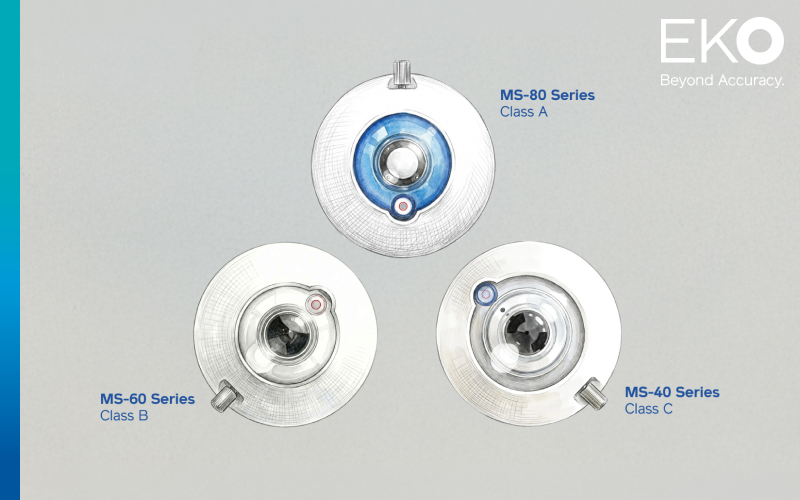
EKO manufactures pyranometers across all three ISO 9060:2018 classes:
- MS-80SH: Class A with integrated dome heating; utility-scale PV in harsh climates
- MS-80S: Class A with S-series smart interface
- MS-80: Class A with analog output
- MS-60S: Class B with smart interface
- MS-60: Class B with analog output
- MS-40S: Class C with smart interface
- MS-40: Class C with analog output
- ML-01: Class C silicon-cell pyranometer
Additionally, every EKO pyranometer leaves an ISO/IEC 17025 accredited laboratory with calibration traceable to the World Radiometric Reference (WRR). This applies to every class.
Making the Final Decision on Pyranometer Class
The pyranometer class conversation ultimately comes down to project economics. If the site generates external-facing reports or exceeds 1 MW, the extra investment in Class A pays back through better decisions and audit compliance. Conversely, for smaller sites and internal-only reporting, Class B or Class C often delivers the right balance of accuracy and cost.
Ready to pick the right pyranometer class for your project? Contact our team for assistance or to request a quote.