

The thermopile vs silicon pyranometer decision affects almost every solar project procurement conversation. Both sensor types measure solar irradiance, but they use fundamentally different physics. As a result, they differ in accuracy, spectral range, response time, cost, and long-term reliability. This guide walks through how each technology works, where each one performs best, and how to match the right sensor to your solar or research project.
How Each Sensor Type Works
Thermopile Pyranometers
A thermopile pyranometer uses a stack of thermocouples arranged under a black-absorber disc. Sunlight heats the disc, and the temperature difference between the hot and cold junctions generates a small voltage proportional to the incident irradiance. Furthermore, a glass or quartz dome sits over the absorber. It protects the sensor and admits the full solar spectrum from 285 to 2800 nanometers.
Thermopile sensors respond slowly, typically reaching 95% of a step change in 5 to 30 seconds. However, they achieve the highest measurement accuracy available and qualify for all three ISO 9060 classes.
Silicon Pyranometers
A silicon pyranometer uses a photodiode that generates an electrical current proportional to the incident photon flux. Photodiodes respond only to a narrow spectral band, roughly 400 to 1100 nanometers, which covers the visible and near-infrared but misses ultraviolet and longer-wave infrared.
Silicon sensors respond fast (under 1 second) and cost significantly less than thermopile alternatives. Moreover, the ISO 9060:2018 revision explicitly recognizes photodiode-based pyranometers, allowing them to meet Class B or Class C thresholds when the manufacturer documents their spectral response.
Thermopile vs Silicon Pyranometer: Head-to-Head
The two sensor technologies differ across every important performance dimension:
- Response time: Thermopile 5 to 30 seconds; silicon under 1 second
- Spectral range: Thermopile 285 to 2800 nm; silicon 400 to 1100 nm
- ISO 9060 class capability: Thermopile A, B, or C; silicon B or C only
- Annual non-stability: Thermopile 0.5 to 1.5%; silicon 2 to 3%
- Directional error: Thermopile 10 to 20 W/m²; silicon 30 W/m² or higher
- Purchase price: Silicon typically 30 to 50% of thermopile cost
Consequently, each technology occupies a distinct niche. In practice, the choice depends on which trade-offs matter most for the project.
Where Thermopile Pyranometers Win
Thermopile pyranometers are the correct choice when the project requires:
- Regulatory compliance. IEC 61724-1 requires Class A pyranometers for utility-scale PV monitoring, which limits the choice to thermopile.
- Long-term stability. A Class A thermopile drifts under 0.8% per year, holding calibration across a five-year deployment.
- Full-spectrum accuracy. The broad spectral response captures the full solar irradiance signal, including UV and near-IR contributions that silicon misses.
- Bankable data. Lenders and investors require Class A thermopile data for solar project financing models.
Where Silicon Pyranometers Win
Silicon pyranometers are the right choice when the project requires:
- Low cost per node. A silicon sensor typically costs 30 to 50% of an equivalent thermopile; therefore, silicon suits dense sensor networks with many measurement points.
- Fast response. Under 1 second response captures cloud transitions and short irradiance spikes that a thermopile averages out.
- Physical robustness. Silicon sensors have no fragile dome, making them well-suited to portable, mobile, or rough-handling applications.
- Small-scale PV. Rooftop and residential PV monitoring rarely justifies Class A accuracy; silicon delivers adequate data at a much lower price.
The Spectral Response Problem
The most important technical difference between thermopile and silicon pyranometers is spectral response. In practice:
A thermopile absorbs the full solar spectrum uniformly. Because of this, its output tracks total incident energy accurately regardless of atmospheric conditions.
Silicon photodiodes, however, only respond to 400 to 1100 nm. When the incident spectrum shifts (for example under cloud cover, at low sun angles, or in humid conditions), the silicon sensor sees a distorted picture of the total irradiance. As a result, silicon-based data typically shows a 3 to 5% bias compared with thermopile reference measurements during these events.
Modern silicon sensors partially correct for this using algorithms, but they cannot fully eliminate the spectral bias.
Choosing Between Thermopile and Silicon by Application
The table below matches common project types to the recommended sensor technology:
- Utility-scale PV (over 1 MW): Thermopile Class A (regulatory requirement)
- Bankable financing: Thermopile Class A (investor requirement)
- Meteorological reference station: Thermopile Class A (research grade)
- Rooftop and small PV (under 100 kW): Silicon (cost-effective, adequate accuracy)
- Agricultural sensor networks: Silicon (many nodes, low cost per point)
- Cloud transition studies: Silicon (fast response captures transients)
- Long-term climate research: Thermopile (stability over 10+ year deployment)
EKO’s Thermopile and Silicon Pyranometer Lineup
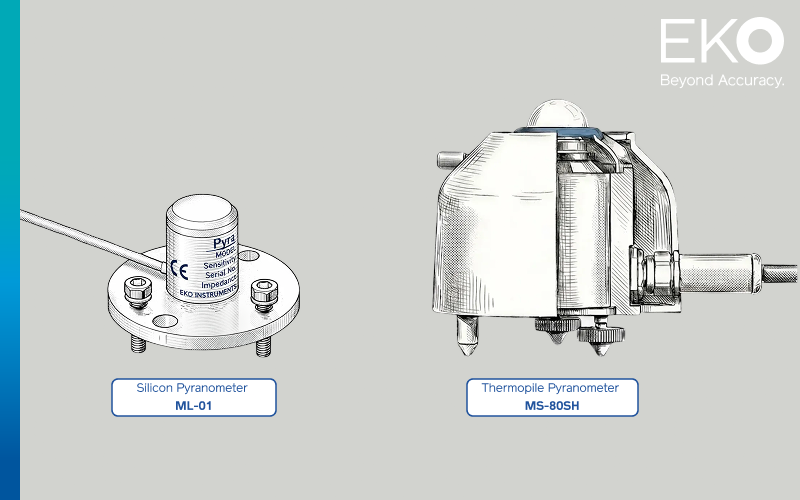
EKO manufactures pyranometers using both technologies:
- Thermopile Class A: MS-80SH, MS-80S, MS-80
- Thermopile Class B: MS-60S, MS-60
- Thermopile Class C: MS-40S, MS-40
- Silicon Class C: ML-01
Every EKO pyranometer, thermopile or silicon, ships from an ISO/IEC 17025 accredited laboratory with calibration traceable to the World Radiometric Reference (WRR) in Davos, Switzerland.
Ready to select the right pyranometer technology for your solar project? Contact our team for assistance or to request a quote.