

Pyranometer maintenance is the cheapest, most effective way to protect the measurement quality of a solar monitoring system. Regular cleaning, leveling checks, and desiccant replacement keep the sensor within its calibrated tolerances. Consequently, they prevent the slow accumulation of measurement errors that distort performance ratio calculations and hide equipment issues. This guide walks through a field maintenance checklist for pyranometers, from weekly visual checks to five-year recalibration.
Why Pyranometer Maintenance Matters
An unmaintained pyranometer generates biased data that looks like real irradiance variation. In practice, four common issues cause silent measurement errors:
- Dome soiling: dust, pollen, salt, or bird droppings scatter and absorb incident radiation. Consequently, the sensor underreports irradiance by 2 to 10% depending on the level of soiling.
- Saturated desiccant: silica gel inside the sensor body absorbs moisture until it saturates. Dew then forms on the inside of the dome, biasing the zero offset upward.
- Un-level sensor: a tilt error of more than 1° introduces a directional error, particularly at low sun angles.
- Cable water ingress: moisture reaching the sensor terminals through a failed cable gland causes signal drift and eventual sensor failure.
Furthermore, none of these show up as a sensor fault. They all appear as bad irradiance data, which then propagates into every downstream calculation.
How Often Should You Perform Pyranometer Maintenance?
The right maintenance interval depends on site conditions, sensor class, and criticality. In general:
- Weekly: visual check for obvious debris, bird droppings, or physical damage
- Monthly: full dome cleaning (more frequent in dusty or coastal environments)
- Quarterly: level check, cable inspection, connector torque check
- Annually: desiccant replacement, mounting hardware inspection
- Every 5 years: ISO/IEC 17025 recalibration (Class A) or every 2 years (Class B and C)
Utility-scale plants in arid or coastal locations often need weekly cleaning during peak dust or salt-spray periods. Moreover, sites with heavy bird populations may require an anti-bird deterrent system in addition to more frequent cleaning.
Field Cleaning Procedure
Follow this five-step procedure for every dome cleaning:
- Choose the right conditions. Clean before sunrise, at sunset, or under cloud cover. Never clean under direct sunlight because thermal shock can crack the glass dome.
- Blow off loose debris. Use a soft brush or a can of compressed air to remove dust, sand, and dry particles before contact cleaning.
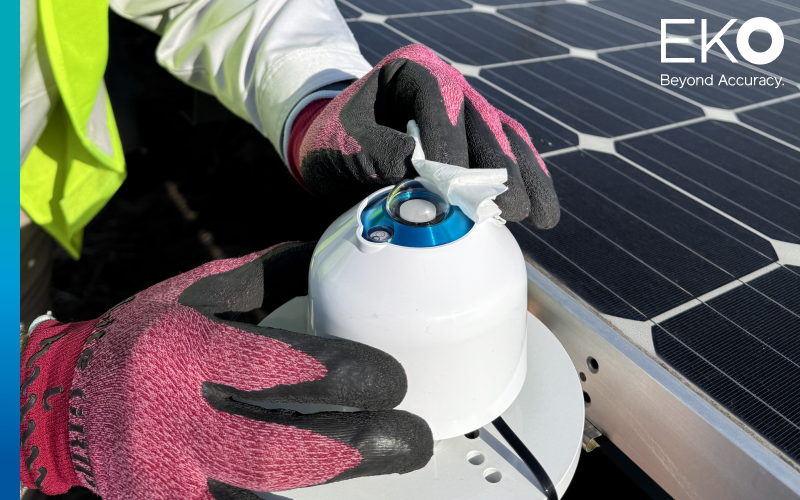
- Wipe with distilled water and microfiber. Apply distilled water only. Tap water leaves calcium and mineral residue that scatters light. Use a soft microfiber cloth in a straight-line motion, not in circles.
- Air dry. Allow the dome to air dry naturally. Do not wipe again to speed up drying; this often leaves streaks.
- Log the cleaning. Record the date, time, and technician in the monitoring system. This log lets the O&M team cross-check data anomalies against maintenance events.
Desiccant Replacement
The silica gel desiccant inside the pyranometer body absorbs internal moisture. However, silica has a finite absorption capacity. Once saturated, it stops working and dew condenses on the inside of the dome.
Three signs indicate a saturated desiccant. First, the dome appears cloudy or fogged, especially in the morning. Second, the indicator crystals change colour (pink or clear). Third, the sensor shows unexplained zero-offset drift.
As a result, most utility PV operators replace desiccant annually as a preventive measure. They also replace it immediately upon seeing any of these signs. Use pre-baked silica cartridges specified for your pyranometer model. Furthermore, log every replacement date so the analyst can trace calibration drift to a specific service event if needed.
Sensor Level Check
A pyranometer must be level within 1° of true horizontal to meet ISO 9060 directional-error thresholds. Most EKO pyranometers ship with an integrated bubble level for field verification.
Check the level quarterly, and re-level after any physical maintenance event or after storms with high winds. Furthermore, verify that the mounting hardware has not loosened over time. A shifted mount introduces tilt errors invisible to the sensor itself.
Cable and Connection Check
Cable and connection issues cause a significant portion of pyranometer failures. Quarterly checks should include:
- Visual inspection of cable for cracking, UV damage, or animal damage
- Cable gland torque check and reseal if necessary
- Connector inspection for corrosion or oxidation
- Continuity check between sensor and logger terminal
In addition, secure any cable strain relief and confirm proper drip loops to prevent water tracking into the sensor body.
Recalibration: The Ultimate Maintenance Task
Cleaning and inspection cannot detect gradual sensitivity drift. Consequently, every pyranometer requires periodic recalibration against a reference standard. EKO Class A pyranometers carry a 5-year recalibration interval. Class B and Class C sensors typically require 2-year recalibration.
EKO’s ISO/IEC 17025 accredited calibration laboratory performs recalibration with traceability to the World Radiometric Reference (WRR) in Davos, Switzerland. Furthermore, comparison against a reference sensor is the only way to confirm the actual sensitivity of a working pyranometer.
Common Pyranometer Maintenance Mistakes
The following mistakes reduce the effectiveness of a maintenance programme:
- Cleaning with tap water. Mineral residue scatters incident radiation and increases the soiling problem.
- Using rough cloths or paper towels. Scratches on the dome cause permanent light scattering.
- Cleaning under direct sunlight. Thermal shock cracks the dome and voids the warranty.
- Skipping the desiccant. Saturated silica creates progressive drift that no cleaning can fix.
- Not logging events. Without a maintenance log, the analyst cannot trace sudden data anomalies to their cause.
EKO Products and Services for Pyranometer Maintenance
EKO supports every stage of the pyranometer maintenance lifecycle:
- MS-80SH: Class A pyranometer with integrated ventilator and heater, reducing manual cleaning frequency
- MV-01 Ventilator and Heater: retrofit accessory for pyranometers in high-humidity or frost-prone sites
- Replacement silica cartridges for MS-series pyranometers
- ISO/IEC 17025 recalibration service
Ready to build a pyranometer maintenance schedule for your project? Contact our team for assistance or to request a quote.