


The 2026 Guide to Solar Sensor Recalibration: Securing Bankability in an Evolving Market
In the solar industry, 2026 represents a pivotal year. This is because a significant wave of utility-scale assets is now reaching the critical two-to-three-year operational cycle. During this period, the integrity of irradiance data becomes a primary driver of financial performance audits. Furthermore, because sophisticated energy yield models depend on physical sensor inputs, asset managers are shifting toward rigorous recalibration policies. Consequently, these audit-ready policies are essential to protect project returns.
The Reality of Sensor Drift
Regardless of initial quality, all solar sensors are subject to environmental degradation. Continuous exposure to ultraviolet (UV) radiation, extreme temperature cycles, and pollutants may cause a gradual drift in sensor sensitivity.
-
Annual Error Rates: High-precision pyranometers can exhibit measurement errors exceeding 2% after just one year. According to the NREL Best Practices Handbook, even premium sensors require regular verification. This ensures they maintain an uncertainty profile acceptable to investors.
-
Impact on PR: Sensitivity drifts lead to inaccurate Performance Ratio (PR) calculations. As outlined in the Solar Bankability Project Best Practices guidelines, technical risks like sensor drift directly inflate the “uncertainty buffer” in financial models.
-
Hidden Drift: Because drift occurs gradually, it often remains invisible on daily monitoring dashboards. Unfortunately, it may significantly skew long-term yield predictions before it is ever noticed.
Why Recalibration is a Financial Imperative
Financial institutions and independent engineers (IEs) are applying increased scrutiny to irradiance data accuracy. Therefore, recalibration has evolved from a simple maintenance task into a direct driver of project valuation.
-
Reducing Uncertainty: High measurement uncertainty forces lenders to adopt more conservative P90 estimates.
-
Contractual Compliance: Many Power Purchase Agreements (PPAs) mandate the use of traceable irradiance data. As defined by ISO 9060:2018, if you use uncalibrated sensors, you may risk rejected warranty claims or liquidated damages.
-
Asset Liquidity: Additionally, a documented “chain of custody” for irradiance data is essential for successful refinancing or secondary market sales.
The 2026 Standards for Compliance
To satisfy current industry standards, asset managers must adhere to specific, standardized recalibration cycles.
-
Two-Year Cycle: The IEC 61724-1:2021 Standard mandates that “Class A” monitoring systems must have their pyranometers recalibrated every two years. This is necessary to maintain data validity.
-
Incident-Based Calibration: Furthermore, sensors should be recalibrated following extreme weather events, such as sandstorms, which may compromise the dome surface quality.
-
Sensor Intercomparison: Intercomparison reveals relative changes by comparing multiple pyranometers under identical conditions. As a result, small sensitivity shifts become immediately visible. Consistent divergence from peer sensors is a strong indicator of calibration drift rather than real irradiance change.
The Gold Standard: ISO/IEC 17025 and Traceability
For recalibration data to be legally and financially defensible, the laboratory must meet international qualifications.
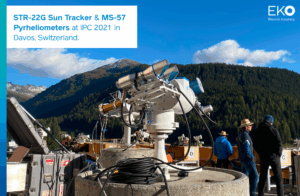
First, ISO/IEC 17025 Accreditation is the definitive standard for laboratory competence. You can verify accredited bodies through the ISO website. Second, all high-quality solar sensors must be traceable to the World Radiometric Reference (WRR) in Davos, Switzerland. To support these requirements, EKO Instruments provides default ISO 17025 accredited calibrations. These services provide the necessary “ground truth” for solar assets.
How the EKO MS-80SH Supports Bankability
The EKO MS-80SH pyranometer is specifically engineered to minimize sensor drift. It features a unique detector that offers exceptional long-term stability. Consequently, these features enable a five-year calibration cycle. This industry-leading interval, documented in the MS-80SH Technical Datasheet, reduces O&M interventions without compromising data reliability.
Conclusion: Protecting the Foundation of ROI
The solar industry is maturing into an era of high-precision asset management. In conclusion, implementing a proactive recalibration policy is no longer optional. By using ISO/IEC 17025 accreditation, you can secure the financial foundation of solar assets throughout their 25-year lifespan.


